Showing posts with label Campbell Kids Mug. Show all posts
Friday, July 15, 2011
Campbell Kids Mug
The Campbell Kids have been selling Campbell's Soup since 1904 when Grace Wiederseim Drayton, an illustrator and writer, added some sketches of children to her husband’s advertising layout for a Campbell's condensed soup. The Campbell advertising agents loved the child appeal and choose Mrs. Wiederseim’s sketches as trademarks. In the beginning, Campbell Kids were drawn as ordinary boys and girls, later, Campbell Kids took on the personas of policemen, sailors, soldiers, and other professions.
Grace Wiederseim Drayton will always be the "mother" of Campbell Kids. She drew for the company advertising for nearly twenty years. Drayton’s designs were so popular that doll makers wanted to capitalized on their popularity. Campbell's gave the E. I. Horsemen Company the license to market dolls with the Campbell label on their sleeves. Horseman even secured two U.S. design patents for the dolls’ clothes.
Today, Campbell’s Soup Company, with its famous red and white label, remains a staple in the kitchen as well as American culture.
Campbell Kids Mug
Campbell Soup Company (NYSE: CPB), also known as Campbell's, is an American producer of canned soups and related products. Campbell's products are sold in 120 countries around the world. It is headquartered in Camden, New Jersey. Campbell's divides itself into three divisions: the simple meals division, which consists largely of soups both condensed and ready-to-serve, the baked snacks division, which consists of Pepperidge Farm, and the health beverage division, which includes V8 juices.
The company was started in 1869 by Joseph A. Campbell, a fruit merchant, and Abraham Anderson, an icebox manufacturer.They produced canned tomatoes, vegetables, jellies, soups, condiments, and minced meats.
In 1876 Anderson left the partnership and the company became the "Joseph A. Campbell Preserve Company".
Campbell reorganized into "Joseph Campbell & Co." in 1896. In 1897, John T. Dorrance, a nephew of the general manager Arthur Dorrance, began working for the company at a wage of $7.50 a week. Dorrance, a chemist with degrees from MIT and Göttingen University, Germany, developed a commercially viable method for condensing soup by halving the quantity of its heaviest ingredient: water. He went on to become president of the company from 1914 to 1930, eventually buying out the Campbell family.
In 1898, Herberton Williams, a Campbell's executive, convinced the company to adopt a cherry red and bright white color scheme, because he was taken by the crisp colors of the Cornell University football team's uniforms. To this day, the layout of the can, with its red and white design and the metallic gold medal seal from the 1900 Paris Exhibition, has changed very little.
Entrance to Campbell Soup headquarters in Camden
Campbell Soup became one of the largest food companies in the world under the leadership of William Beverly Murphy. He was elected executive vice president of Campbell Soup in 1949 and was President and CEO from 1953 to 1972. While at Campbell's Soup Company, he took the corporation public and increased its brand portfolio to include Pepperidge Farm's breads, cookies, and crackers, Franco-American's gravies and pastas, V8 vegetable juices, Swanson broths, and Godiva's chocolates. David Johnson was President and CEO from 1990 until 1997.
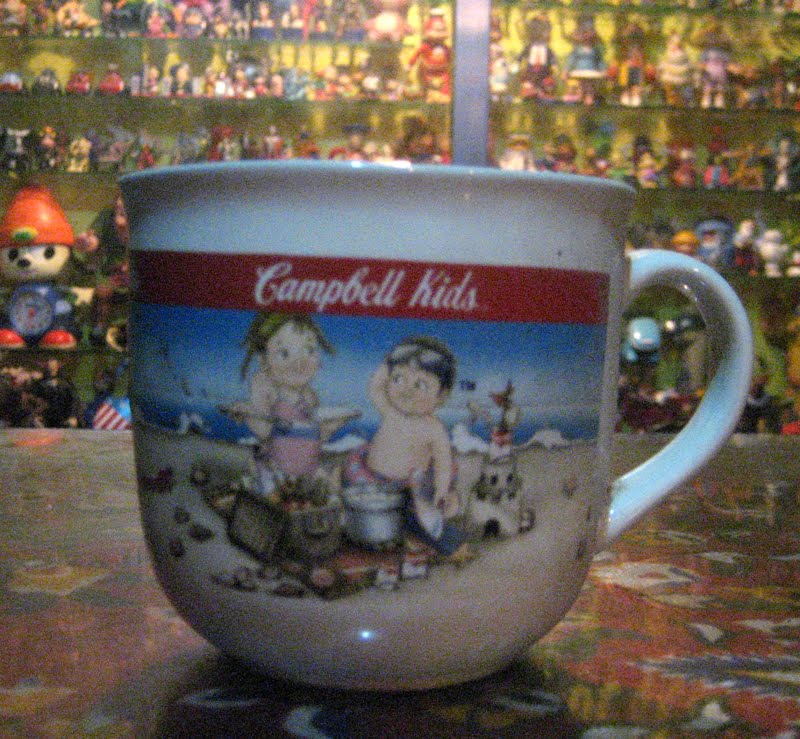
Campbell Kids Mug
In 1962, artist Andy Warhol took the familiar look of the Campbell's soup can and integrated it into a series of pop art silkscreens, a theme he would return to off and on through the 1960s and 1970s. The first batch in 1962 were a series of 32 canvases. At first, the cans were accurate representations of actual Campbell's cans, but as his series progressed, they became more surrealistic, with Warhol experimenting with negative-reversed color schemes and other varied techniques (many of these which would be used on other Warhol paintings of the period, such as his celebrity silkscreens of the 1960s). The silkscreens themselves have become iconic pieces of pop art, with one in particular, Small Torn Campbell Soup Can (Pepper Pot) (1962), commanding a price of $11.8 million at auction in 2006.
In 2004, Campbell's themselves recognized Warhol's art by releasing in the eastern United States a limited-edition series of cans that were inspired by the coloring and silkscreen effects of Warhol's pieces. This marked one of the few times in the company's history that they would change the trade dress for their main canned-soup line in any substantial manner.
Campbell Kids Mug
Campbell Soup invested heavily in advertising since its inception, and many of its promotional campaigns have proven value in the Americana collectible advertising market. Perhaps best known are the "Campbell Kids" designed by illustrator Grace Drayton. Ronald Reagan was a spokesman for V8 when Campbell's acquired the brand in 1948.
In addition to collectible advertising, the company has also had notable commercial sponsorships. Among these was The Campbell Playhouse, which had previously been Orson Welles's Mercury Theatre On The Air. Campbell's took over as sponsor of the radio theater program in December 1938.
In the UK and Ireland, Campbell Soup was rebranded as Batchelors Condensed Soup (UK) and Erin (Ireland) in March 2008, when the license to use the brand name expired. Premier Foods, St. Albans, Hertfordshire bought the Campbell Soup Company in the UK and Ireland, for £450m ($830m) in 2006, but was licensed to use the brand only until 2008. Under this agreement the US-based Campbell Soup Company will continue to produce Campbell's Condensed Soup but cannot sell the product in the UK for a further 5 years.
Campbell's continues to be a major part of Camden, regularly participating in charity events in the community. It also has recently completed the building of a new and expanded headquarters in the city.
In January 2010, Campbell's Canadian subsidiary began selling a line of soups that are certified by the Islamic Society of North America as being halal (prepared in accordance with Islamic law). Although Campbell does not have any plans to sell its halal soups in the United States, the move has drawn criticism from anti-Muslim advocates in the United States. Blogger Pamela Geller called for a boycott of the company.
In January 2011, It was announced that the Campbell's Soup brand would be returning to the UK and would be on the shop shelf later in the month. The brand will be Manufactured under license by Symingtons. The new line-up comprises 12 cup soups, five simmer soups designed to be cooked in a pot of water four savoury rice lines and four savoury pasta and sauce packets. The new range will not be sold in tins, but instead sold in packets and boxes. Later in 2011 the canned varieties have also returned to supermarket shelves with refreshed labels and new lines.
Subscribe to:
Posts (Atom)


